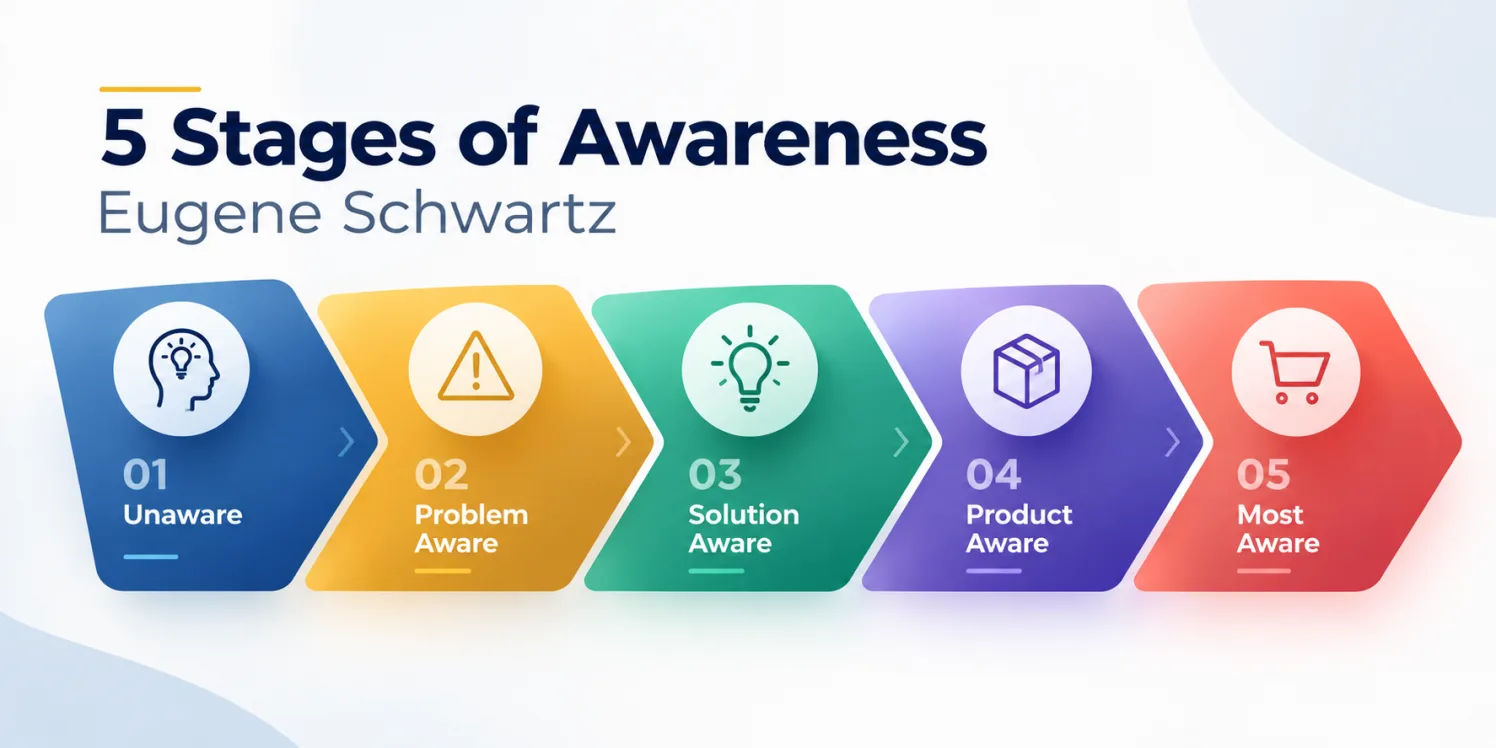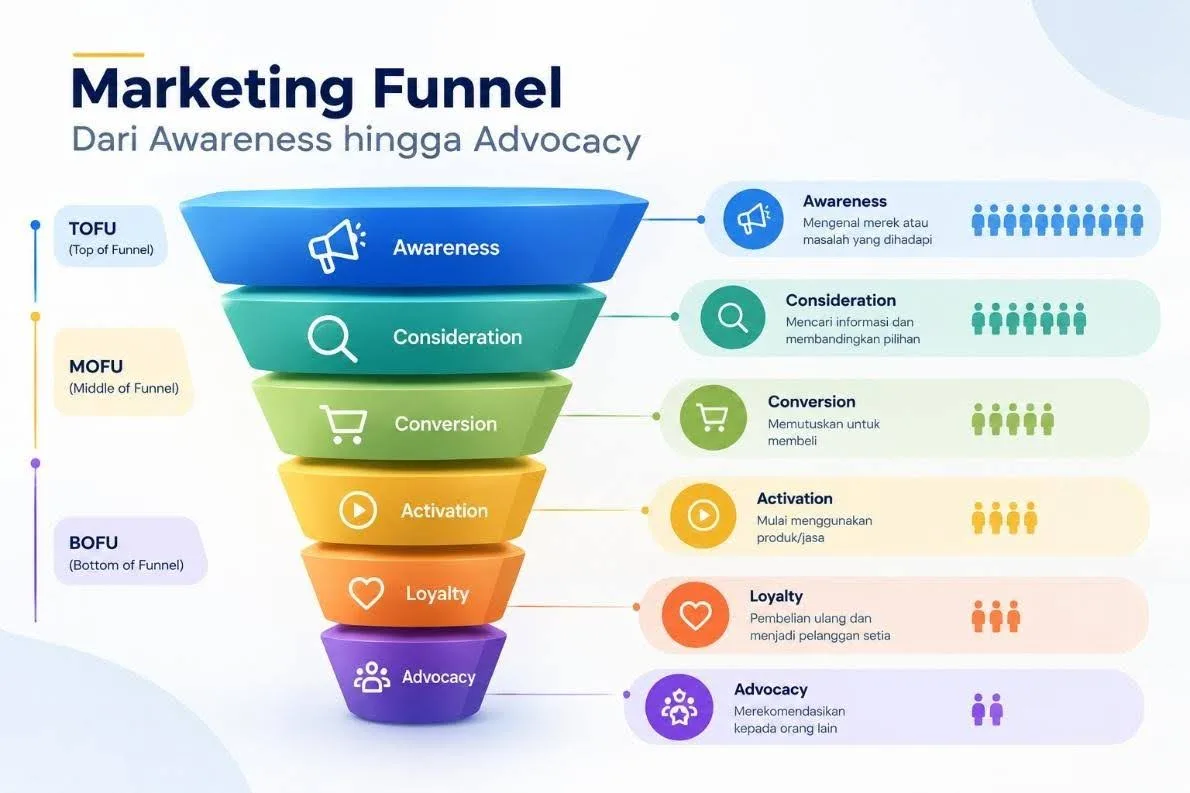
A marketing funnel is a framework that describes a prospective customer’s journey, from getting to know a brand to becoming a loyal customer who recommends the product to others.
In practice, the consumer journey does not always run in a straight line. However, a marketing funnel helps businesses understand what consumers think and do at each stage, so that marketing strategies can be tailored to their needs.
In general, a marketing funnel can be divided into three main parts: TOFU (Top of Funnel), MOFU (Middle of Funnel), and BOFU (Bottom of Funnel).
TOFU – Awareness
TOFU (Top of Funnel) is the stage at which consumers begin to become aware of a problem, a need, or a brand.
At this stage, consumers do not necessarily intend to buy. The business focuses on building attention and introducing the value it offers.
Example:
Someone sees content about food recommendations on social media and begins to recognize GoFood as one of the available food delivery services.
Strategies that can be used:
SEO and informative articles
Social media
Videos and educational content
Digital advertising
Influencers or KOLs
Goal: to build awareness and draw prospective consumers into the funnel.
MOFU – Consideration & Conversion
At the MOFU (Middle of Funnel) stage, consumers are already interested and begin to consider whether a particular product or service suits their needs.
Consideration
Consumers begin to look for information and compare different options.
Example:
A consumer who wants to buy coffee starts comparing Kopi Kenangan, Fore Coffee, and other coffee shops based on price, taste, location, promotions, and ease of ordering.
Strategies that can be used:
Product comparisons
Reviews and testimonials
Product knowledge content
Product demonstrations
Free trials or samples
FAQs and pricing information
Conversion
After considering the various options, consumers begin to decide to make a purchase.
Example:
The consumer chooses Kopi Kenangan because there is a suitable promotion, the outlet is nearby, and ordering through the app is easy.
Strategies that can be used:
Promotions and vouchers
Limited-time offers
Easy checkout
A variety of payment methods
A clear call to action
MOFU goal: to turn interest into a purchase decision.
BOFU – Activation, Loyalty & Advocacy
BOFU (Bottom of Funnel) does not end when the transaction takes place. Its focus is on ensuring that consumers have a good experience, buy again, and even recommend the product.
Activation
Activation is the stage at which consumers begin to experience and use the product after making a purchase.
Example:
New app users have their first experience with the GoFood service and begin to try the available payment features and promotions.
Businesses need to ensure that this first experience is easy and delivers real benefits.
Loyalty
After a positive experience, consumers are expected to make repeat purchases and become loyal customers.
Example:
A customer regularly buys the same skincare product because it suits them and they receive a loyalty program or special offers.
Strategies:
Membership programs
Loyalty points
Personalized offers
Customer-only promotions
Good customer service
Advocacy
The highest stage is when customers are willing to recommend the product to others.
Example:
A customer who is satisfied with a restaurant leaves a positive review, shares the experience on social media, or recommends it to friends.
Strategies:
Referral programs
Reviews and ratings
User-generated content
Customer communities
Reward programs for referrals
BOFU goal: to build customers who are active, loyal, and become brand advocates.
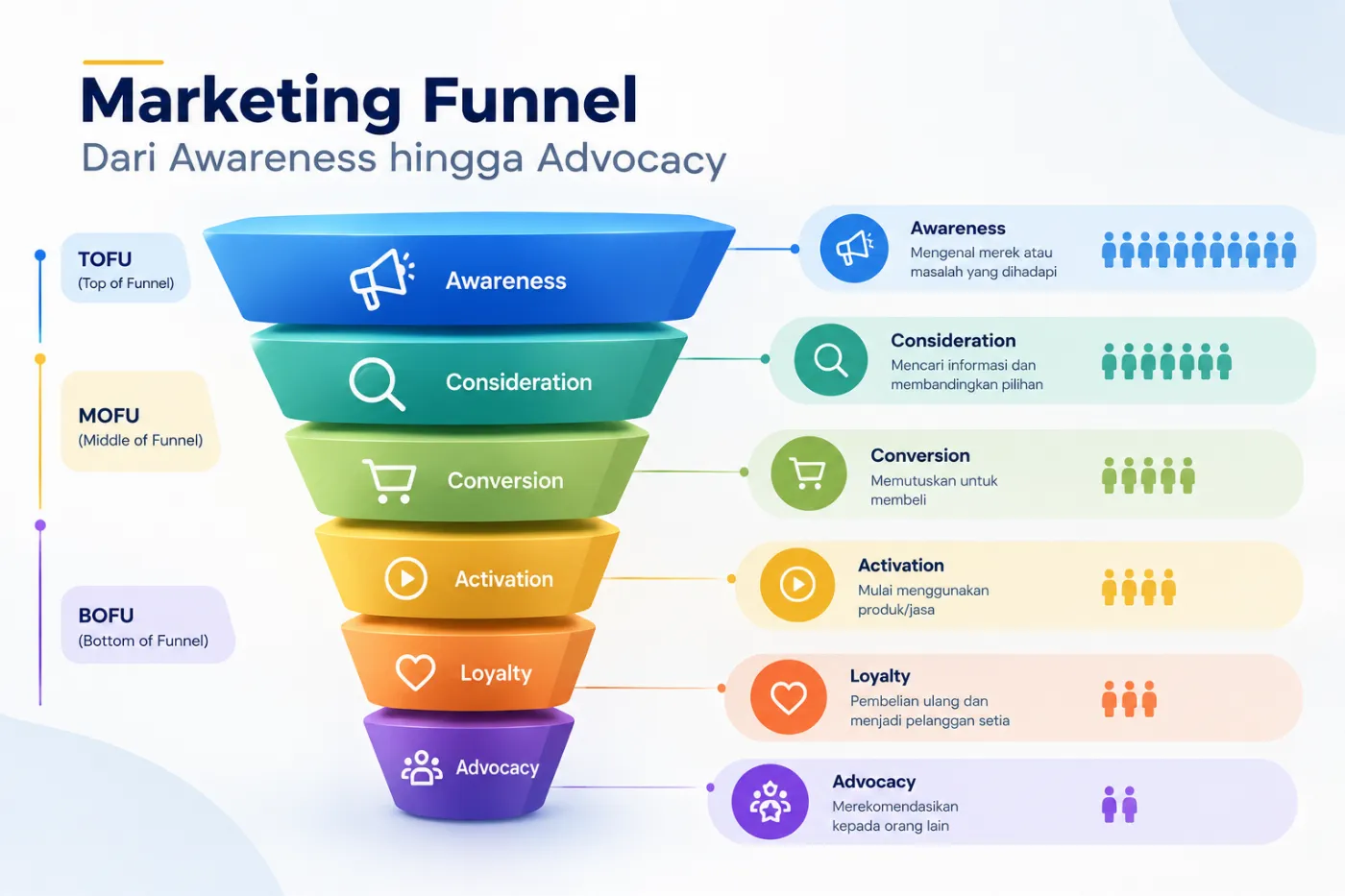
The Marketing Funnel in a Single Flow
| Funnel | Stage | Consumer Behavior | Business Focus |
|---|---|---|---|
| TOFU | Awareness | Recognizes a problem or brand | Attracting attention |
| MOFU | Consideration | Looks for information and compares | Persuading |
| MOFU | Conversion | Decides to buy | Encouraging transactions |
| BOFU | Activation | Starts using the product | Creating a positive experience |
| BOFU | Loyalty | Buys again | Retaining customers |
| BOFU | Advocacy | Recommends the product | Encouraging word of mouth |
Why Is the Marketing Funnel Important?
A marketing funnel helps businesses understand that each consumer needs a different approach. Someone who has just discovered a product needs different communication from a customer who is ready to buy or one who is already loyal.
In digital marketing, this concept can be used to determine the type of content, media, message, and success indicators at each stage.
Thus, a marketing funnel is not merely a tool for chasing sales; it also helps businesses build a more focused customer journey from awareness to advocacy.
Conclusion
A marketing funnel can be understood through three main stages:
TOFU → Awareness
↓
MOFU → Consideration → Conversion
↓
BOFU → Activation → Loyalty → Advocacy
This flow shows that marketing success is measured not only by how many people buy, but also by a business’s ability to create experiences that make customers buy again and willing to recommend the product to others.
References
Schwartz, E. (1966). Breakthrough Advertising.
HubSpot. Stages of the Marketing Funnel: How to Build Yours.
Kotler, P., & Keller, K. L. Marketing Management.