When may a company recognize revenue? Is it when the goods are shipped, when the customer pays, or when the company receives an advance payment? This question is one of the key concepts in financial accounting. In practice, revenue is not always the same as the cash a company receives. For transactions with customers, revenue recognition must follow PSAK 115: Revenue from Contracts with Customers, the Indonesian accounting standard that adopts IFRS 15. PSAK 115 uses a contract-based approach and sets out principles for determining the nature, amount, timing, and uncertainty of revenue and cash flows arising from contracts with customers.
So how do we determine when revenue may be recognized? PSAK 115 uses a five-step model: (1) identify the contract with the customer, (2) identify the performance obligations in the contract, (3) determine the transaction price, (4) allocate the transaction price to the performance obligations, and (5) recognize revenue when or as the performance obligations are satisfied. This means that receiving money from a customer does not necessarily mean the company can recognize revenue immediately. For example, a company receives an advance payment of Rp120 million to provide services over 12 months. If the company has not yet provided those services, the money received does not automatically become revenue in full at the outset. The company needs to consider its performance obligations and recognize revenue as those obligations are satisfied. Under certain conditions, revenue can be recognized over time, not only at a single point in time.
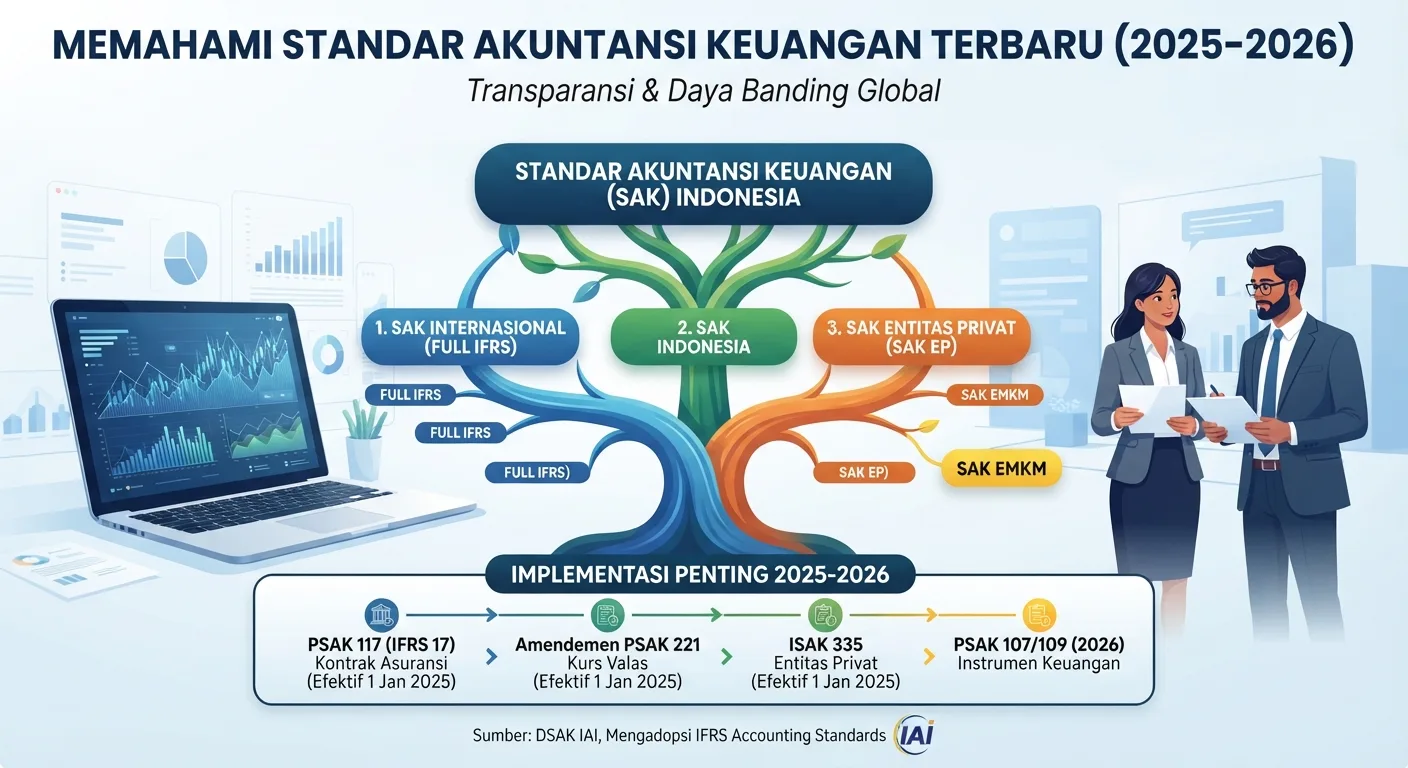
This is why revenue recognition is so important in accounting. The timing of revenue recognition affects profit, receivables, contract assets or liabilities, and the company’s financial performance. Getting the timing of revenue recognition wrong can cause the current period’s profit to be overstated or understated. Students also need to understand that transactions such as discounts, sales returns, variable consideration, long-term contracts, customer loyalty programs, and principal-agent relationships may require further analysis. PSAK 115 is currently the main standard for recognizing revenue from contracts with customers; the Institute of Indonesia Chartered Accountants (IAI) has also issued various implementation materials to help apply PSAK 115 to complex transactions.
So stop using the simple principle that “cash in = revenue”. In accounting, the more appropriate question is: “Has the company satisfied its performance obligations to the customer?” If the answer is no, revenue may not yet be recognized. Conversely, revenue can be recognized when or as the company satisfies its performance obligations in accordance with the applicable provisions. Understanding this concept will help students not only solve journal entry exercises but also understand how companies can report revenue and profit accurately without misleading users of financial statements.