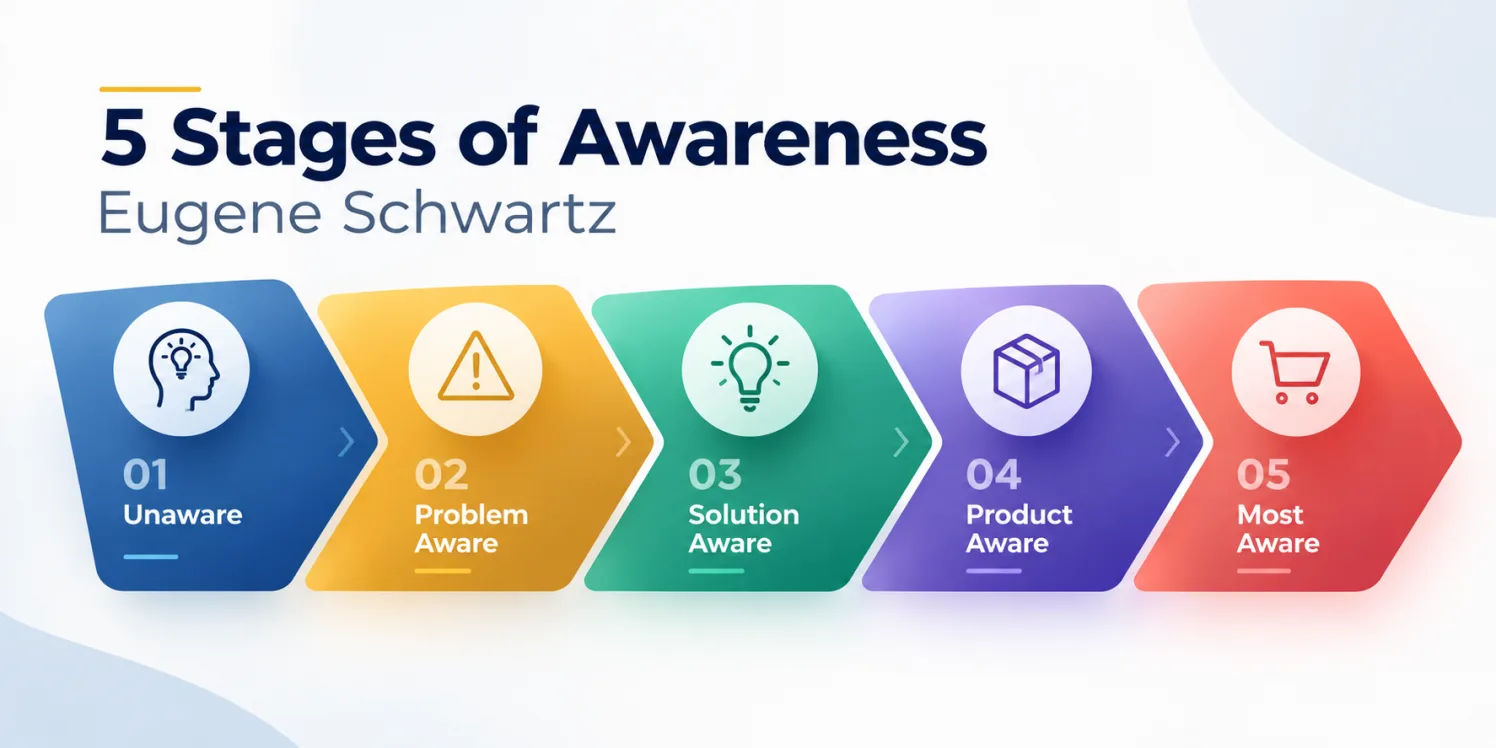
In marketing, every consumer has a different level of knowledge about a problem, its solutions, and the products available. Effective marketing messages therefore need to be tailored to the consumer’s level of awareness.
Eugene Schwartz’s 5 Stages of Awareness concept helps marketers understand this journey, from consumers who are not yet aware of a problem to consumers who are ready to buy. The framework is rooted in the concept of the state of awareness in Eugene M. Schwartz’s book Breakthrough Advertising.
The five commonly used stages are Unaware, Problem Aware, Solution Aware, Product Aware, and Most Aware.
Unaware – Not Yet Aware of the Problem
Consumers are not yet aware that they have a particular problem or need.
Example: someone is still using an old smartphone that keeps getting slower, but considers it normal.
Suitable content does not offer a product straight away; instead, it builds awareness.
Example:
"5 Signs Your Smartphone Is Starting to Hold Back Your Productivity"
The goal is to make consumers realize that the problem really exists.
Problem Aware – Aware of the Problem
Consumers are aware of the problem but do not yet know the right solution.
For example, smartphone users begin searching for:
- "Why is my phone so slow?"
- "How to stop my phone battery draining fast"
- "Why does my phone overheat?"
At this stage, marketers need to provide education about the problem and its possible solutions.
Example:
"Slow Phone? 5 Causes and How to Fix Them"
Solution Aware – Aware of the Solutions
Consumers know that solutions are available but have not yet decided which product or brand to choose.
For example, consumers begin searching for:
- "Best phone for work"
- "Best camera phone"
- "Best phone for students"
They begin comparing options such as Samsung, Apple, Xiaomi, OPPO, and vivo.
Example:
"7 Things to Consider Before Buying a Smartphone for Work"
The marketing focus at this stage is helping consumers understand and compare solutions.
Product Aware – Familiar with the Product
Consumers already know a particular product or brand but are still considering whether it is the best choice.
For example, a consumer is already interested in the iPhone but is still weighing up the model, price, camera, performance, and its advantages over other products.
At this stage, communication needs to present proof, benefits, advantages, reviews, testimonials, and differentiation.
Example:
"iPhone Series X vs Series Y: Which One Suits Your Needs?"
The goal is to reduce doubts before purchase.
Most Aware – Ready to Buy
Consumers already know the problem, the solution, and the product they want. They usually need only one final reason to make the purchase, such as price, a promotion, a bonus, or an easy transaction.
For example, a consumer has already decided which skincare product to buy and searches for:
"Latest Skintific price" or "Skintific promo today."
The marketing message can be more direct:
"Skintific 5X Ceramide – Special Promo Today + Free Shipping."
At this stage, consumers do not need lengthy education. They need an offer that prompts the purchase decision.
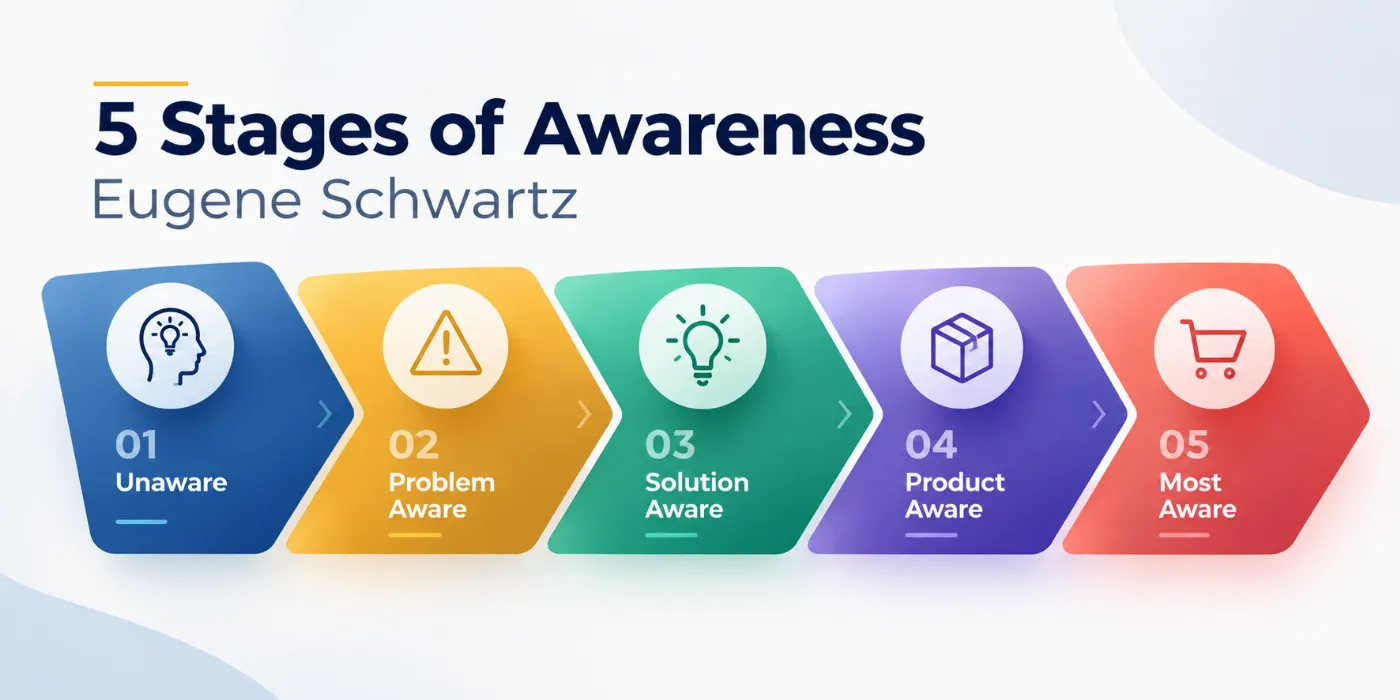
Examples of the 5 Stages of Awareness in Marketing
| Stage | Consumer Condition | Example Search | Marketing Focus |
|---|---|---|---|
| Unaware | Not yet aware of the problem | "Why is my phone getting slower?" | Building awareness |
| Problem Aware | Aware of having a problem | "How to fix a slow phone" | Educating about the problem |
| Solution Aware | Knows the solutions | "Best phone for work" | Education & comparison |
| Product Aware | Familiar with the product | "Samsung A vs Samsung S" | Proof & differentiation |
| Most Aware | Ready to buy | "Samsung S promo price" | Price, promotions & CTA |
Why Are the 5 Stages of Awareness Important?
A common mistake in marketing is giving the same message to every consumer.
Consumers who are not yet aware of a problem obviously need a different approach from consumers who are already looking up a product’s price.
The core principle of the 5 Stages of Awareness is therefore:
Deliver the right message to consumers based on what they already know.
This concept can be applied in marketing strategy, digital marketing, SEO, content marketing, copywriting, digital advertising, and the customer journey.
In SEO, for example, marketers can create content ranging from educational articles for Unaware consumers, solution articles for Problem Aware consumers, and comparison articles for Solution Aware consumers, to reviews for Product Aware consumers and product and promotion pages for Most Aware consumers.
By understanding consumers’ level of awareness, companies do not just sell products; they build relevant communication at every stage of the consumer journey.
Conclusion
Eugene Schwartz’s 5 Stages of Awareness describes five levels of consumer awareness:
Unaware → Problem Aware → Solution Aware → Product Aware → Most Aware.
Understanding these stages helps marketers decide what to say, when to say it, and how direct the sales message should be.
Ultimately, effective marketing is not just about having a good product, but about the ability to understand what consumers already know and what they need to know next.
References
- Schwartz, E. M. (1966). Breakthrough Advertising. Prentice-Hall.
- Landra. (2026). Eugene Schwartz's 5 Stages of Awareness for DTC Brands.
- PageLint. (2026). Schwartz Awareness States Explained.