Artificial Intelligence (AI) is becoming ever closer to everyday life. We use it to search for information, create content, analyze data, and even support business work.
However, there is one side of AI that is rarely seen: the water needed behind the technology.
Why does a digital technology that seems to need only electricity also turn out to need water? And is it true that using AI can worsen water resource problems?
AI Does Not Drink Water, but Data Centers Need It
When we use AI, we obviously do not see the water being used directly. The water is used by data centers, the facilities that house and run the servers behind various digital services.
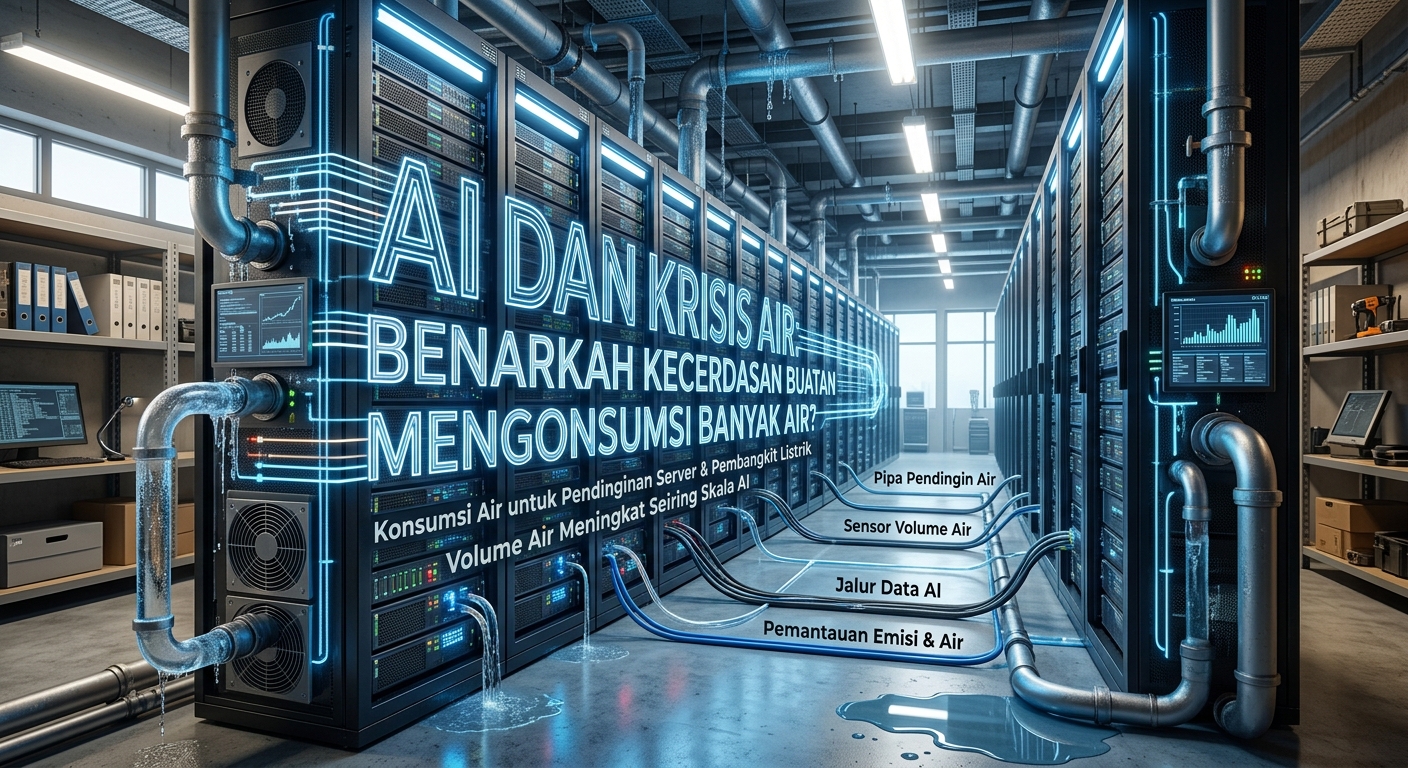
Servers generate large amounts of heat when performing computations. Data centers therefore need cooling systems. In some facilities, water is used in the cooling process, especially in systems that rely on evaporation.
In addition, water can also be used indirectly through the generation of the electricity that powers data centers. The production of the chips used to run AI also has a water footprint.
In other words:
AI → requires computation → requires electricity → generates heat → requires cooling systems → may require water.
How Much Water Does AI Use?
This is the part that often causes misunderstanding.
Various studies do show that AI has a water footprint. However, there is no single figure that applies to every AI query.
Water use depends heavily on:
the type of servers used;
computational efficiency;
the cooling system;
the location of the data center;
climate conditions;
the source of electricity;
and the type of AI work being performed.
A 2025 study even found that water use across data center workloads can differ by more than 10,000 times.
This means that claims such as "every time you ask an AI a question, it uses up so many liters of water" should be read with caution.
Why Is This Issue Becoming More Important?
The use of AI is growing very quickly. Along with it, the need for computing power and the construction of data centers is also increasing.
The International Energy Agency (IEA) estimates that global data center electricity consumption will rise significantly through 2030. AI is one of the main drivers of this growth.
The greater the need for computing, the more important it becomes to discuss energy and water efficiency.
A study published in Water Research in 2026 estimates that AI’s global water footprint could reach 4.2–6.6 billion cubic meters per year by 2027. This figure is a projection and carries uncertainty, as it is influenced by technology, location, and the growth of AI use.
The Problem Is Not Just the Amount of Water, but Where It Is Used
There is something more important than simply calculating how much water is used.
Where is that water being used?
Data centers located in regions with abundant water resources are obviously in a different situation from data centers in regions experiencing water stress.
The development of AI infrastructure therefore needs to take local water resource conditions into account. Recent research also highlights the importance of including water availability in data center planning.
AI and the Challenge of Sustainable Business
The issue of water use shows that the development of AI is not only a matter of technology.
It is also a matter of economics and business.
Technology companies need to think about:
How can we build AI that remains profitable while using resources efficiently?
This question relates to the concept of ESG (Environmental, Social, and Governance).
Companies can consider using more efficient cooling technologies, improving server efficiency, choosing data center locations strategically, and increasing transparency about water use. Various studies show that a combination of technological efficiency and location planning can reduce the water footprint of data centers.
Should We Stop Using AI?
It is not that simple.
AI offers many benefits to society and the business world. The technology can increase productivity, help with data analysis, support innovation, and open up new business opportunities.
The issue is not simply whether or not to use AI, but how the technology is developed and used more responsibly.
This is what has given rise to the idea of Sustainable AI.
The future of AI needs not only increasingly intelligent models but also infrastructure that is increasingly efficient, transparent, and sustainable.
What Does This Mean for the Younger Generation?
For students and young people who will enter the business world, this issue offers an important lesson.
Technology and sustainability can no longer be separated.
Future entrepreneurs, managers, and business leaders need to understand that business decisions are not only about profit but also about their impact on the environment and society.
AI can be a powerful technology. However, the next challenge is ensuring that this sophistication does not come at an environmental cost that is ignored.
Conclusion
Is it true that AI uses a lot of water?
Yes, AI has a water footprint. Water can be used for data center cooling, electricity generation, and the production of the hardware that supports AI infrastructure.
However, the amount is not the same for every use of AI. Technology, location, cooling systems, electricity sources, and data center efficiency all strongly determine how much water is used.
The important question for the future is therefore not only:
"How intelligent is AI?"
But also:
"How sustainable is the AI we are building?"
This question will become increasingly important as the digital economy develops and the use of AI in business grows.
References
Lei, N., Lu, J., Shehabi, A., & Masanet, E. (2025). The Water Use of Data Center Workloads: A Review and Assessment of Key Determinants. Resources, Conservation and Recycling.
de Vries-Gao, A. (2025). The Carbon and Water Footprints of Data Centers and What This Could Mean for Artificial Intelligence. Patterns.
Herrera, M., et al. (2025). Sustainable AI Infrastructure: A Scenario-Based Forecast of Water Footprint Under Uncertainty. Journal of Cleaner Production.
International Energy Agency. (2025). Energy and AI.
The Water Footprint of Artificial Intelligence: Emerging Solutions and Governance Imperatives. Water Research, 2026.